

Read the op-ed in the San Francisco Chronicle
Most people in California recognize Lake Tahoe, the “Jewel of the Sierra,” for its crystalline waters, stunning landscape and seemingly endless opportunities to enjoy nature.
Despite the lake’s enduring appeal, invasive species have long posed a threat to its pristine water quality. Nonnative plants and animals outcompete native species, degrade water quality and can cripple infrastructure in lakes, rivers and streams where they spread.
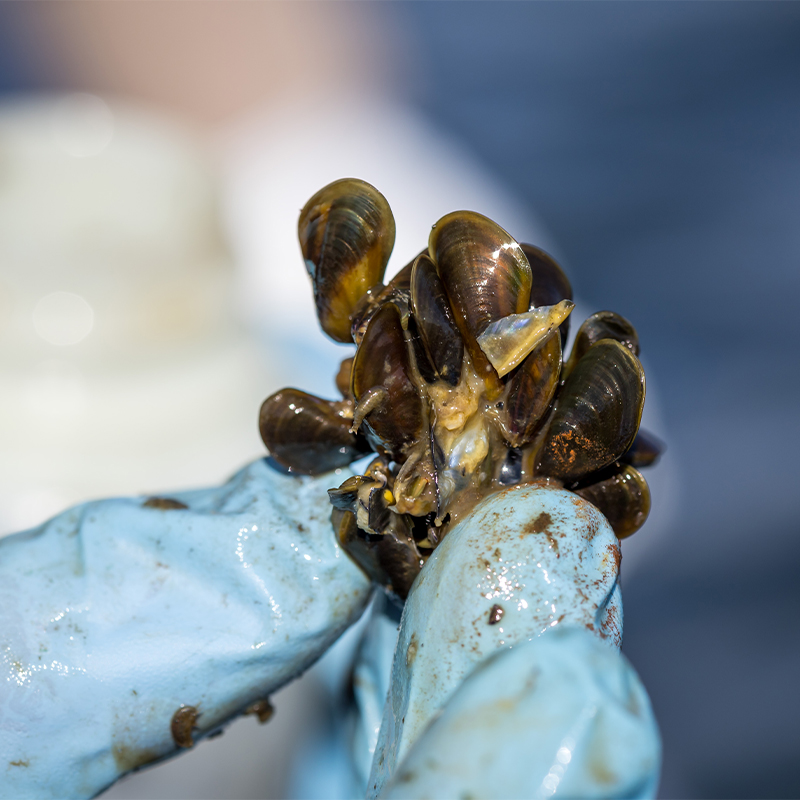
But one invader in particular has become a pressing concern: the golden mussel. There is no greater threat today to Tahoe’s iconic water quality than the golden mussel, which is already on the lake’s doorstep.
On May 31, a boat unknowingly carrying four golden mussels attached to its underside was stopped at a Tahoe inspection station after it had visited waterways near Sacramento. The boat was intercepted and not allowed to launch on Lake Tahoe. If golden mussels are allowed in, they will exponentially accelerate the lake’s slow shift from blue to green, and the region will lose the ability to take management and remediation actions to halt or even slow down the greening.
Lake Tahoe has one of the nation’s strongest aquatic invasive species prevention programs, which has been built over decades and includes mandatory watercraft inspections and decontaminations. These measures have protected Tahoe from zebra mussels, quagga mussels, and now, the growing threat of golden mussels, which are native to China and Southeast Asia.
That is why recent decisions at Lake Oroville to eliminate mandatory inspections for golden mussel prevention are deeply concerning — not just for that reservoir, but for waters across California and the West.
We should be using strong deterrent programs like Lake Tahoe’s as a standard requirement, not an option on a menu, when our water in California is at risk.
Golden mussels reproduce rapidly, can survive for days out of the water and attach to nearly any hard surface, including boats, trailers, paddles and fishing gear. A single golden mussel can produce a million offspring in a year, which can clog drinking water and hydroelectric infrastructure, damage irrigation systems, foul marinas and boat ramps, alter aquatic food webs and increase harmful algal growth — unless they are stopped with effective control methods. Yet, prevention at all of California’s waterways is not a state requirement.
Golden mussels are not a hypothetical danger; they are a real threat to all the places where Californians swim, boat and get their water supply. Since they were first detected in North America in the Sacramento-San Joaquin Delta in October 2024, they have spread rapidly across California, stretching as far south as San Diego County.
The threat is already being recognized not only by local counties surrounding the Delta, but also by our federal lawmakers in the Senate and the House, who introduced legislation last month to address this problem. In response to the worsening infestation, officials in Kern and San Joaquin counties, over 200 miles away from one another, have declared a state of emergency.
California’s water system is heavily interconnected, meaning an unchecked infestation could negatively impact reservoirs, water conveyance systems, hydropower facilities, agriculture, fisheries, recreation and local economies across the state. Once established, these impacts are not temporary; they become a never-ending, expensive management burden.
The Delta, which is infested with golden mussels, is one of the state’s busiest boating hubs. The second most common destination for boaters after visiting the Delta is Lake Tahoe, according to officials from the California Department of Fish and Wildlife. In other words, there is a direct pathway for golden mussels to enter Lake Tahoe, and once they are established, eradication will be virtually impossible.
Prevention is the only realistic strategy. It has worked before in Lake Tahoe due to an incredibly strong partnership among government agencies, nonprofit organizations such as Keep Tahoe Blue, and the engaged community, all working together.
All visiting boats and jet skis must be inspected and decontaminated before they can launch into Lake Tahoe’s most precious resource. Paddlers, anglers and beachgoers are instructed to clean, drain and dry all nonmotorized water gear — paddleboards, kayaks, canoes, fishing tackle, water shoes, even floaties — before they touch the water. Paid staff and volunteers roam popular beaches to spread the message, and Keep Tahoe Blue hosts free seminars on how to identify and report aquatic invasive species sightings.
Other waterways in California have also responded to the golden mussel threat by enhancing watercraft inspections and decontaminations. Lake Berryessa, Folsom Lake and the New Melones Dam are even requiring quarantines.
Keep Tahoe Blue supports strong, science-based prevention measures statewide. But prevention only works if protection is consistent. When one reservoir weakens inspections while others maintain rigorous standards, it creates gaps that invasive species can exploit.
We are asking the California Legislature to require measures to protect all of our state’s major waterways. California urgently needs consistent statewide watercraft inspection and decontamination regulations to address the growing threat of golden mussels and other aquatic invasive species. A patchwork approach leaves lakes, rivers, reservoirs, infrastructure and local economies vulnerable. Strong statewide standards would provide clarity for boaters, improve coordination among agencies and help protect waterways across California — including Lake Tahoe — before it is too late.
Laura Patten is the natural resource director of Keep Tahoe Blue