

When most people think of pollution at Lake Tahoe, they picture trash on the beach or in the surrounding area. But a growing threat is harder to see. Every mile a vehicle travels, its tires shed particles. Those fragments get left on Tahoe roads, get washed away during rain or snowstorms into the environment and storm drains, and eventually settle in the Lake — contributing to clarity loss and threatening aquatic life.
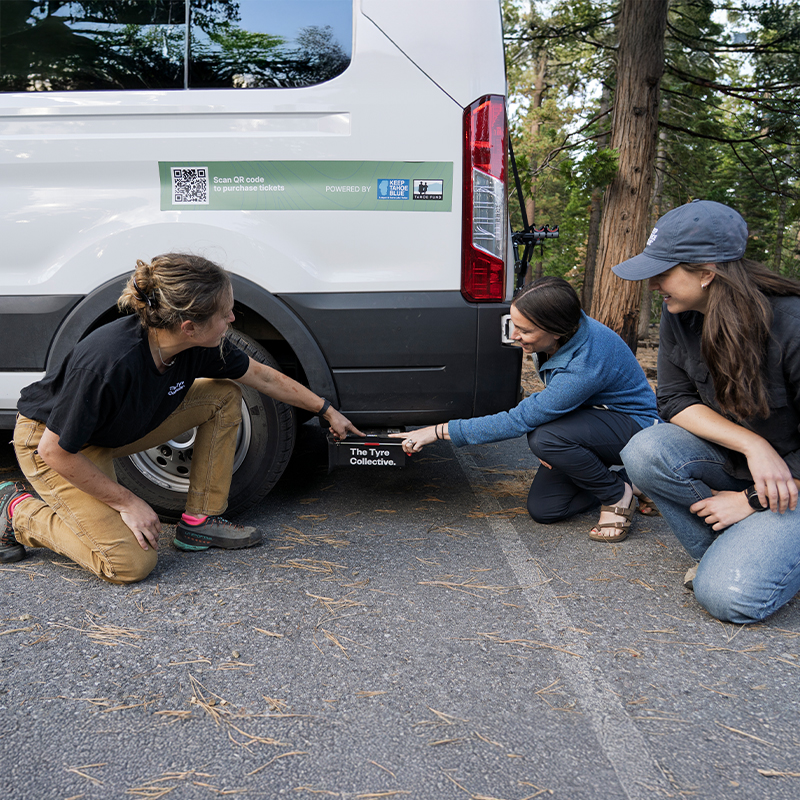
This summer, Keep Tahoe Blue, The Tyre Collective, and the Desert Research Institute (DRI) teamed up on a first-of-its-kind pilot project. The goal: capture tire particles at the source and study how much they contribute to Tahoe’s water quality challenges.
Why tire pollution matters for Lake Tahoe’s clarity
Tire wear doesn’t look like litter, but its impacts are significant:
- Microplastics: synthetic particles that persist in water and never fully break down.
- 6PPD-q: a chemical found in tire additives that is toxic to fish and linked to salmon die-offs in West Coast rivers.
- Fine sediment: already the leading cause of Lake Tahoe’s clarity loss, which can bind with other pollutants and magnify their impact.
Together, these invisible pollutants threaten Tahoe’s clean water, healthy wildlife, and famously clear air. Scientists are just beginning to understand their reach.
How the Emerald Bay pilot worked
Think of it as a tiny filter positioned near a tire. Compact devices designed by The Tyre Collective were mounted beneath Emerald Bay Shuttle vehicles. For four weeks, while the shuttle carried visitors to and from one of Tahoe’s most iconic destinations, the devices silently collected tire particles that would otherwise have escaped into the environment.
By pairing this technology with a shuttle that removes cars from one of Tahoe’s busiest highway corridors, the pilot shows how innovation and alternative transportation can work hand-in-hand to reduce impacts on the Lake.
“While we know that vehicles impact water quality and Lake clarity, this project will help us better understand exactly how,” said Laura Patten, natural resource director at Keep Tahoe Blue. “That knowledge is critical to creating solutions that protect this national treasure.”
What scientists hope to learn
The captured material is being analyzed by DRI researchers and Keep Tahoe Blue’s science team. The findings will:
- Measure how much tire pollution enters Tahoe’s environment under real-world conditions.
- Reveal how toxic chemicals like 6PPD-q are released by tires.
- Add to global research on microplastics and tire wear, using Tahoe as a clear-water test site.
Tire wear is a silent but significant source of pollution. The pilot wrapped up in late September, but the data will continue to inform Tahoe’s protection efforts and contribute to worldwide understanding of tire pollution.
How you can help protect Tahoe
Everyone has a role to play in reducing traffic-related pollution:
- Ride instead of drive: Use alternative transportation options like the Emerald Bay Shuttle, Lake Link, TART Connect, or other shared transit options. Fewer cars mean less tire wear and cleaner air.
- Fuel Tahoe science: Support Keep Tahoe Blue. Your donations power innovative pilots, long-term monitoring, and practical solutions that protect the Lake’s clarity.
- Share Tahoe’s story: Help raise awareness by sharing updates with friends, neighbors, and visitors.
Tahoe leading the way
Lake Tahoe’s clarity makes it an ideal testing ground for new pollution-detecting technology. The insights from this study will ripple far beyond the Basin, shaping how communities worldwide address tire pollution.
This collaboration reflects what Keep Tahoe Blue does best: pair science with practical tools and community action. Even pollutants you can’t easily see can be managed with smart testing and proven behaviors — building a clearer, healthier future for Lake Tahoe, and setting an example for watersheds everywhere.