Since Keep Tahoe Blue was founded nearly 70 years ago, our victories for the Lake have been the result of combining science, direct engagement with government decision makers, and persistence. It can take years and sometimes decades to shape public policy and secure the sustainable funding needed to protect Tahoe. Our team remains committed to methodically building relationships and support, taking advantage of opportunities when they arise, and making sure Tahoe gets the government support it deserves - just like we have from the start.
Your generosity supports our multi-year advocacy efforts that are critical to Tahoe's future. Thanks for your support. |
|
|
|
Our Campaign
WATER QUALITY & CLARITY |
|
|
|
New tools to stop the spread of Aquatic Invasive Species |
What is it?
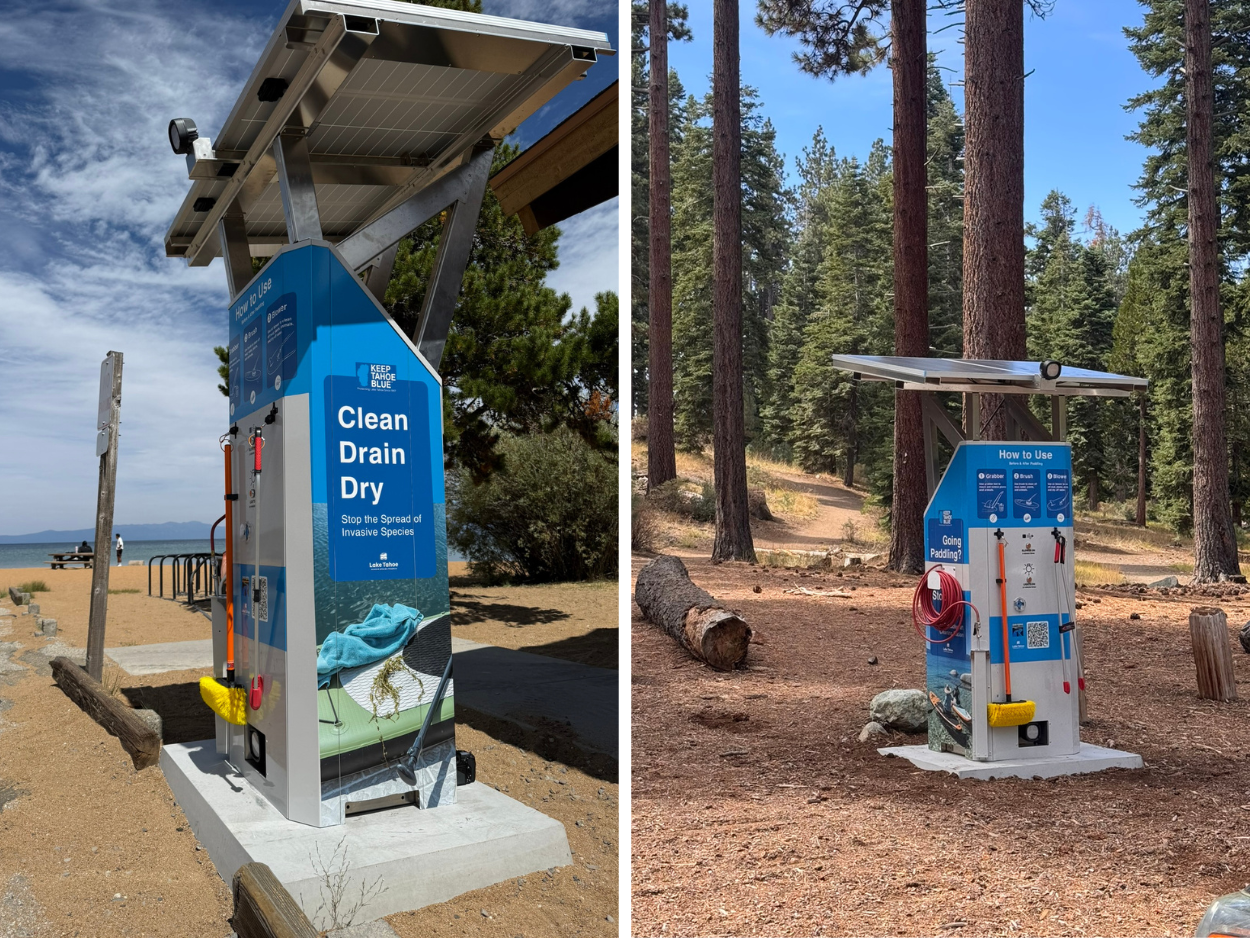
"CD3 Outpost Blue" machines are self-service aquatic invasive species (AIS) prevention stations designed specifically for non-motorized watercraft, including paddleboards, kayaks, canoes, rafts, floaties, and fishing equipment. They are a tool to address the growing threat of golden mussels and other aquatic invasive species that can be transported on wet or contaminated gear. Keep Tahoe Blue led the installation of four new Outpost Blue machines in Tahoe this month. Each Outpost Blue provides tools such as a brush, grabber, and compressed air so recreators can Clean, Drain, and Dry their equipment before entering Lake Tahoe and nearby waterbodies. The goal is to make AIS prevention easy and accessible, particularly for users who do not pass through Tahoe's existing motorized boat inspection stations.
Keep Tahoe Blue is leading the CD3 Outpost Blue project as a proactive expansion of Tahoe's AIS prevention system. Keep Tahoe Blue provided funding for the new machines, is working with the CD3 manufacturer and agency partners on future design improvements and placement, developing educational messaging and signage, and helping integrate the stations into broader AIS outreach. The project builds on our previous deployment of a mobile, trailer-mounted CD3 unit and on-the-ground education with our Eyes on the Lake Outreach Team volunteers.
Where is it in the process?
In early September, Keep Tahoe Blue installed four custom, non-motorized CD3 Outpost Blue machines at Baldwin Beach and Fallen Leaf Lake. The units are intended to complement Tahoe's robust boat inspection program, which requires all motorized watercraft to be inspected and decontaminated before launching at one of Tahoe's marinas or launch ramps. Nonmotorized watercraft are just as likely to carry AIS, but they can enter the water from anywhere. The new CD3 Outposts are an additional tool to fill the gap in AIS prevention for nonmotorized gear.
What's next?
The next phase of the project is to build public awareness, so recreators know how and why to use the Outpost Blue machines. Keep Tahoe Blue will also evaluate the machines' use and effectiveness, identify opportunities for additional locations, and continue advocating for stronger and more consistent non-motorized AIS prevention across Lake Tahoe, California, and Nevada. In the longer term, the Outpost Blue machines can provide a model for other high-use waterbodies to address the threat of golden mussels and other invasive species.
What is Keep Tahoe Blue's position? SUPPORT
The Outpost Blue machines advance Keep Tahoe Blue's position that preventing invasive species from entering Lake Tahoe is far more effective, environmentally responsible, and cost-effective than attempting to control them after they've established a new population. The machines also help close an important gap in the current prevention system by giving nonmotorized recreators easy, free, and practical tools to Clean, Drain, and Dry their equipment.
Climate connection:
Climate change can increase Lake Tahoe's vulnerability to aquatic invasive species by altering water temperatures, hydrology, and ecosystem conditions in ways that may favor the establishment or spread of some invasive species. At the same time, Tahoe is experiencing high recreational use and increasing movement of watercraft and equipment among California and Nevada waterways. Strengthening AIS prevention increases the Lake's ecological resilience by reducing an additional stressor on an ecosystem already responding to a changing climate.
More information: |
|
|
|
Our Campaign
CLIMATE RESILIENCE |
|
|
|
Proposed Rescission of the Federal Roadless Rule |
What is it?
The 2001 Roadless Area Conservation Rule (Roadless Rule) protects designated zones (inventoried roadless areas) within national forests across the United States by generally restricting new road construction, road reconstruction, and timber harvesting, with important exceptions for activities such as certain wildfire prevention and forest health work. These protections have helped conserve some of the nation's largest remaining undeveloped forest landscapes and the clean water, wildlife habitat, and recreation opportunities they provide.
The federal government is now pursuing a nationwide rescission of the Roadless Rule. The U.S. Forest Service (USFS) has said rescission would remove national restrictions from nearly 45 million acres and shift more decisions about roads and timber harvest to individual national forests.
Keep Tahoe Blue is advocating to retain Roadless Rule protections in the Lake Tahoe Basin. We are engaging with the USFS, Tahoe Regional Planning Agency (TRPA), elected officials, partners, and the public to highlight the consequences that rescission could mean for Tahoe, including fragmented wildlife habitat, erosion that degrades Tahoe's unique water clarity, a likely increase in wildfire ignitions with the use of heavy equipment, and damage to the local recreation-based economy. We are also urging TRPA to engage in the federal process because changes to management of roadless lands could affect the environmental thresholds the agency is responsible for attaining and maintaining.
Where is it in the process?
USFS is undertaking a federal rulemaking process to rescind the Roadless Rule. The agency has stated that the process will include notice-and-comment rulemaking, an Environmental Impact Statement under the National Environmental Protection Act, Endangered Species Act compliance, and Tribal consultation. This is particularly significant for Lake Tahoe because roughly 80% of the land in the Basin is managed by the USFS, and approximately 23% of the Basin is within inventoried roadless areas, meaning a national policy change could have substantial local consequences.
What's next?
Keep Tahoe Blue will continue tracking and providing comment in the federal environmental review and rulemaking process, evaluating potential impacts to Lake Tahoe, and advocating for continued protection of Tahoe's inventoried roadless areas with our partners and decision makers. The USFS is accepting public comments on the proposed rescission of the Roadless Rule until October 6, 2026. What is Keep Tahoe Blue's position? OPPOSE
Keep Tahoe Blue opposes rescission of the Roadless Rule. We support retaining strong protections for Tahoe's inventoried roadless areas. These lands provide important safeguards for watersheds, wildlife habitat, recreation, and forest ecosystems. Removing nationwide protections could increase the potential for road construction and other development in areas that have remained largely undeveloped for decades.
Importantly, protecting roadless areas does not mean opposing responsible forest management or wildfire resilience work. The existing rule contains exceptions and Keep Tahoe Blue supports science-based forest management needed to protect Tahoe's communities and ecosystems while maintaining safeguards against unnecessary new roads and development. Climate connection:
Tahoe's roadless forests are part of the Basin's natural climate resilience system. Intact forests store carbon, protect watersheds, provide connected habitat that allows wildlife to respond to changing conditions, and reduce erosion and sediment movement into streams and Lake Tahoe. Maintaining large, connected landscapes is increasingly important as Tahoe experiences climate-driven changes in wildfire, drought, precipitation, and ecosystem conditions.
More information: |
|
|
|
Our Campaign
CONSERVATION ACROSS BORDERS |
|
|
|
California Legislative Advocacy: Transportation & Aquatic Invasive Species |
What is it?
This year, Keep Tahoe Blue engaged in two important California legislative efforts that aligned with our Conservation Across Borders strategic priority. AB 2679 (Hadwick) sought to give local partners more flexibility to improve transportation, visitor safety, and parking management in Emerald Bay, while AB 1772 (Papan) proposed a statewide framework to prevent the spread of harmful golden mussels and other aquatic invasive species. Keep Tahoe Blue's government affairs team advocated directly with state lawmakers and agency partners on both pieces of legislation. We provided testimony, technical expertise, and education highlighting the connection between state policy decisions, Lake Tahoe's water clarity, visitor access, and ecosystem protection. Our engagement also included sharing recent successes, including pilot travel management programs like the Emerald Bay Shuttle, as well as the region's nationally recognized aquatic invasive species prevention program, both of which may serve as models for broader statewide solutions.
Where is it in the process?
Ultimately, the two bills did not advance out of the Legislature due to budgetary concerns. However, the discussions, hearings, and government affairs work helped elevate Tahoe's needs and brought greater attention to solutions that protect Lake clarity, public safety, and ecosystem health.
What's next?
The two bills created important momentum for future action. For transportation, Keep Tahoe Blue will continue advancing solutions for transit, parking management, and visitor safety in Emerald Bay through regional partnerships, while also planning to take advantage of future legislative opportunities. For aquatic invasive species, we will continue advocating for stronger state and federal prevention measures while expanding education, outreach, and on-the-ground programs that help keep golden mussels out of Tahoe. One key lesson from this year's efforts is that building broad statewide coalitions and demonstrating the economic and environmental benefits of Tahoe-tested solutions will be critical to securing future legislative success.
What is Keep Tahoe Blue's position? SUPPORT
Keep Tahoe Blue supported both bills because they advanced proactive, science-based solutions to reduce environmental impacts before they become larger and more expensive challenges. Better transportation options help reduce congestion, roadway impacts, and pollution while stronger aquatic invasive species prevention measures help protect Tahoe's water quality and native ecosystem. Climate connection:
Climate change intensifies many of Tahoe's challenges. Transportation remains a significant source of greenhouse gas emissions, while warming air and water temperatures create conditions that can make it easier for aquatic invasive species to establish and spread. Investing in sustainable transportation and prevention-focused invasive species policies strengthens Tahoe's long-term climate resilience. More information: |
|
|
|
Our Campaign
SUSTAINABLE RECREATION, TRANSPORTATION & DEVELOPMENT |
|
|
|
East Shore Parking Impacts |
What is it?
For years, Tahoe's popular recreation hotspots have been inundated by illegal and unsafe roadside parking. This puts pedestrians and motorists at risk, and it leads to negative environmental impacts from erosion and runoff from unpaved highway shoulders into the Lake, as well as litter, graffiti, and human waste from large numbers of people using unmanaged public lands that lack proper infrastructure.
Keep Tahoe Blue has worked for years to alleviate these impacts. Our team has worked with the Nevada Department of Transportation (NDOT) to block parking in sensitive areas, activated our volunteer Tahoe Blue Crews to remove litter from highway shoulders and unmanaged beaches, installed trash infrastructure and restrooms at the popular Spooner Summit sled hill, and facilitated new modes of alternative transportation.
One area that is consistently hit hard with user impacts is Tahoe's East Shore. The State Route 28 Corridor Plan, introduced in 2013, proposes a solution: replace roadside parking with managed parking lots that are connected to one another and town centers by public transit and multi-use trails. The managed parking lots would funnel users along erosion-resistant engineered paths to beach sites that are equipped with the facilities needed to mitigate environmental impacts, including trash cans, dumpsters, restrooms, and educational signage. The first phase of the State Route 28 Corridor Plan was the construction of the East Shore Trail, a bike and pedestrian path completed in 2019 that connects managed parking lots in Incline Village to Sand Harbor State Park. In this stretch of the corridor, roadside parking has been replaced with managed parking at Tunnel Creek and transit service is provided in the summer, serving as a model for the corridor.
Similar improvements slated for the entire corridor, between Incline Village and Spooner Summit, are too expensive to be made at once, so they are being built in phases according to the State Route 28 Corridor Plan. As a result, some user impacts have been displaced until all improvements are completed.
Where is it in the process?
In late May 2026, a new, 130-spot managed parking lot opened at Chimney Beach. No Parking signs were installed along the stretch of highway surrounding the new lot, yet there have not been adequate resources for police enforcement to deter illegal parking along the highway. As a result, Keep Tahoe Blue's cleanup efforts have recorded more environmental impacts on nearby beaches, including human waste and graffiti, than in years past.
Our organization is advocating for engineered solutions to restrict illegal and unsafe roadside parking to prevent impacts from increased parking capacity and recreation.
What's next?
NDOT has a large construction project slated to begin in 2029, which includes construction of permanent barriers to block illegal off-highway parking along State Route 28 and minimize water quality impacts to the Lake. In the meantime, Keep Tahoe Blue is working with NDOT, the USDA Forest Service, and Tahoe Regional Planning Agency to implement temporary solutions, including blocking parking with snow stakes or guideposts, and increased enforcement. We will continue to activate our volunteers to pick up litter. Our team is also engaged in public education about the environmental impacts of Tahoe's dependence on private car travel, in addition to facilitating and promoting Lake-friendly transportation as part of our vision for a Car-Free, Care-Free Tahoe.
The State Route 28 Corridor Plan calls for additional managed parking lots to be built at Secret Harbor, south of Chimney Beach, and near Spooner Lake State Park.
What is Keep Tahoe Blue's position? OPPOSE Keep Tahoe Blue is opposed to increasing parking capacity along the East Shore, or any high-demand recreation site. Eliminating existing illegal parking must happen concurrently with opening new parking lots.
We support the State Route 28 Corridor Plan's goal of shifting existing visitation to better managed areas. Parking in managed lots creates revenue that stays in the corridor for maintenance of recreation sites, including restrooms and trash receptacles, as well as funding for Lake-friendly transportation solutions. However, a lag between construction and enforcement must be avoided. With additional managed parking areas planned to be built along the East Shore and West Shore in the future, it is critical to set a precedent now for how to align engineering, education, and enforcement, so the Lake is not impacted. Climate connection:
Transportation systems that are largely reliant on fossil fuels are one of the largest contributors to climate change globally. In Tahoe, the transportation sector is the second largest contributor to greenhouse gas emissions. Reducing emissions makes climate resilience and adaptation efforts more achievable and effective. More information: |
|
|
|
Tahoe Keys Marina Redevelopment Project |
What is it?
In 2021, Suntex Marinas acquired the Tahoe Keys Marina and has begun a multi-year effort to modernize the aging facility, add clean boating infrastructure, and address environmental impacts. Keep Tahoe Blue has been working closely with the marina owner since the purchase to ensure their operations, along with in-water and upland development plans, protect the Lake. Additionally, we worked with partner agencies to develop draft permit conditions - obligations that the marina owner must satisfy to comply with the Tahoe Regional Planning Agency's (TRPA) regulations - focused on reducing environmental impacts, particularly around aquatic invasive species (AIS), water quality, marina operations, and traffic. We are also advocating for improved transit, bike, and non-motorized watercraft access, and extensive environmental education on-site.
In parallel, we have been directly engaged with the marina owner to negotiate environmental protections that go above and beyond what can be required through permit conditions. Those added protections are part of a legally binding Memorandum of Understanding (MOU) that places requirements on the marina owner while Keep Tahoe Blue maintains its independent voice and full capacity as an environmental watchdog. This is a new tool that our team is using to hold development projects to a higher standard, one that leaves Tahoe better than before.
Where is it in the process?
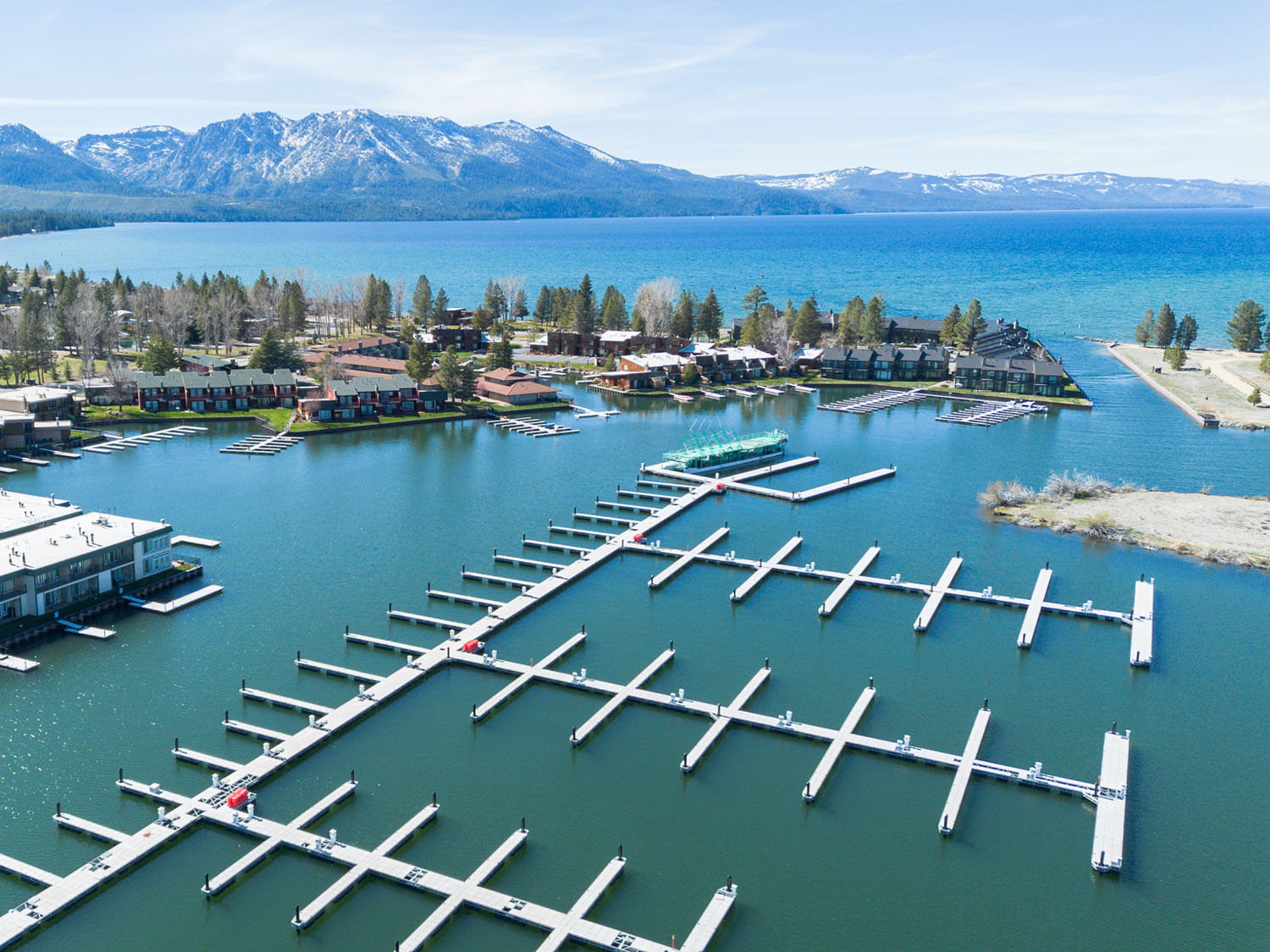
The first phase of the redevelopment project began after the end of 2025 boating season with full replacement of the marina's 305 deteriorating boat slips that regularly released plastics, including Styrofoam, into the water. The new docks and slips are made of durable HDPE (high-density polyethylene), are ADA-compliant, include 50-amp outlets for electric boat charging, and have fire suppression features throughout.
While the dock replacement was underway, our team worked closely with the marina to refine the redevelopment plans for the site's upland areas, including removal of old buildings, reconfiguration of the site, and design of new buildings and public spaces. The marina owner brought its proposed plans to the City of South Lake Tahoe's Planning Commission, which provided its approval on June 11. The Sierra Club Tahoe Area Group and Tahoe Sierra Clean Air Coalition appealed that decision to the South Lake Tahoe City Council, which denied the appeal on August 11. The proposed plans were also heard by the Tahoe Regional Planning Agency's Governing Board (TRPA) on June 28. TRPA approved the plan and amendments to its code of ordinances, allowing for a proposed boat storage barn to be taller than previously allowed under its rules.
What's next?
With the redevelopment plan approved, the marina owner is now applying for the numerous permits needed to proceed with the project, reflecting the scale of the project and the importance of careful environmental review in the Tahoe Basin. Upland construction of the Tahoe Keys Marina redevelopment project could begin as early as 2027. What is Keep Tahoe Blue's position? CONDITIONAL SUPPORT
Keep Tahoe Blue is working to ensure that strong environmental safeguards are in place before determining our final position on the project, consistent with our approach of waiting until environmental review is complete and protections are secured. At this point, we support the commitments made by the marina owner to go above and beyond what's required, and we appreciate their meaningful engagement. Climate connection:
The project has implications for climate-related Lake impacts, including increased boating activity and associated emissions, water quality stressors that can exacerbate algae growth, and the spread of AIS. By advancing AIS prevention measures and water quality protections through permit conditions and the MOU, Keep Tahoe Blue is working to reduce these long-term climate-related risks. More information: |
|
|
|
Policy Change for “Monopine” Cell Towers |
What is it?
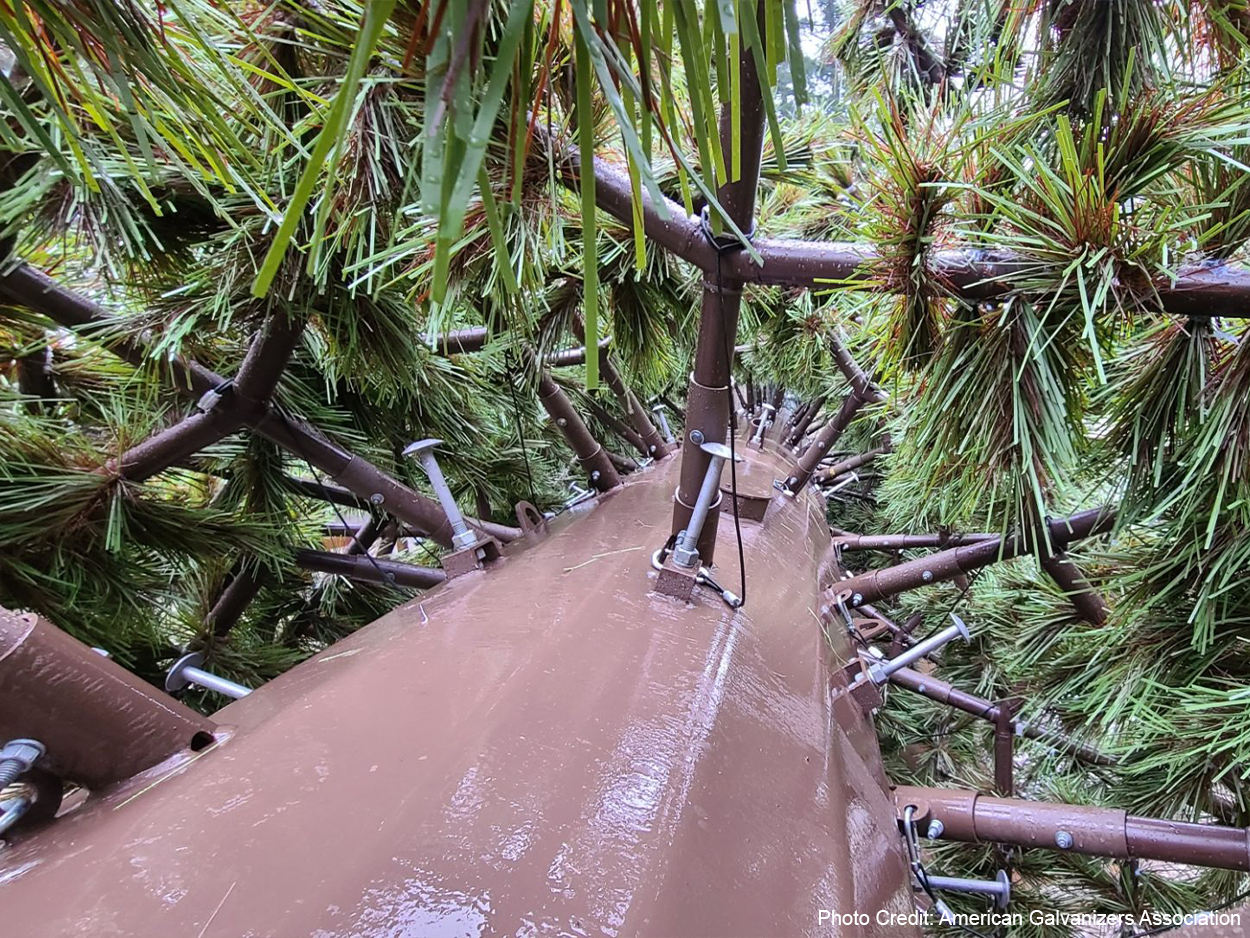
"Monopines" are cell towers designed to look like pine trees, using artificial branches and plastic needles. But those plastic materials can deteriorate under Tahoe's intense sun, wind, snow and freeze-thaw conditions, breaking apart and introducing plastic trash and potentially microplastics into the environment. In Tahoe, monopines were originally favored over traditional cell towers to blend in with their surroundings and avoid damaging Tahoe's scenic quality.
Keep Tahoe Blue volunteers first helped bring attention to the issue after repeatedly finding pieces of plastic "pine needles" from monopines during community cleanups. Keep Tahoe Blue staff elevated those observations, connected them with our broader work on microplastic pollution research and prevention, and advocated for the Tahoe Regional Planning Agency (TRPA) to change its policies so that protecting Tahoe's scenic quality does not inadvertently create another source of plastic pollution.
Where is it in the process?
Keep Tahoe Blue's volunteers, combined with our plastic prevention work and advocacy efforts, led to results. In June 2026, the TRPA Governing Board approved changes to its review process for monopine telecommunications towers. The new approach allows TRPA to apply alternative design standards to mitigate or prevent deterioration and shedding of synthetic materials while continuing to protect Tahoe's scenic resources. Keep Tahoe Blue submitted formal comments supporting the changes and encouraging TRPA to prioritize durable, non-plastic alternatives.
What's next?
Keep Tahoe Blue will track how the new standards are implemented as new and replacement telecommunications facilities are reviewed. We will continue advocating for materials and designs that meet Tahoe's scenic standards without creating unnecessary sources of persistent plastic pollution. More broadly, we'll continue using cleanup and citizen science data to identify emerging pollution sources and turn what our volunteers see on the ground into practical policy solutions that protect Tahoe.
What is Keep Tahoe Blue's position? SUPPORT
Keep Tahoe Blue supports TRPA's policy changes as a common-sense, source-reduction approach to microplastic pollution. Once plastics fragment into smaller particles and disperse through Tahoe's environment, removing them is extremely difficult. Preventing plastic pollution before it enters the environment is a more effective solution. This policy change is also a great example of our Science to Solutions approach: volunteers identified a problem through years of cleanup work, Keep Tahoe Blue staff connected those observations to emerging microplastics science, and advocacy helped translate that information into a change in regional policy.
Climate connection:
Tahoe's high elevation environment exposes plastics to intense ultraviolet radiation, wind, snow loading, and freeze-thaw cycles that can accelerate deterioration. Climate change can add additional stress through changing temperature extremes, wildfire conditions, and other environmental pressures. Choosing more durable materials reduces waste and makes Tahoe's infrastructure more resilient over the long term. More information: |
|
|
|
We're Keeping An Eye On It |
|
|
|
Affordable Housing
Keep Tahoe Blue recognizes that Tahoe needs more housing for local workers and families, but solutions must not come at the expense of Lake Tahoe's environmental health or water quality. Throughout the Tahoe Regional Planning Agency's multi-year "Cultivating Community, Conserving the Basin" (Housing Phase 3) process, we have advocated for a balanced approach that integrates housing (placed in areas with existing infrastructure), environmental protection (with a focus on stormwater management), as well as expanding Lake-friendly transportation options (to reduce miles driven by commuters). Earlier this year, our team submitted detailed scoping comments on the project's Environmental Impact Statement (EIS), emphasizing the need for strong environmental safeguards and science-based analysis. Public scoping is now complete, and TRPA expects to release a draft EIS in late 2026, along with a public comment period. We'll continue to engage where it counts to ensure Tahoe's housing future supports, rather than undermines, the Lake's long-term health.
California Proposition 45
California voters will consider Proposition 45 this November, a statewide measure that would weaken the California Environmental Quality Act (CEQA), the law that helps ensure environmental impacts are disclosed and addressed before projects move forward. While Tahoe's unique protections extend beyond CEQA alone, strong environmental review remains an important tool for protecting clean water, wildlife habitat, and community input across California. Keep Tahoe Blue has joined a broad coalition opposing the measure because it could reduce oversight of projects with significant environmental impacts while providing no guarantee of lower housing costs or utility bills. We'll continue tracking this issue and advocating for policies that protect the natural resources and environmental safeguards upon which communities like Tahoe depend.
Caldor Fire Restoration Project
Five years after the Caldor Fire, Keep Tahoe Blue and the Tahoe Science Advisory Council are funding an independent scientific assessment to better understand how Tahoe's forests are recovering. The project combines a scientific literature review with field surveys of natural conifer regeneration across the Caldor Fire footprint. The research will help identify where forests are recovering naturally, where active reforestation may be appropriate, and which management approaches are supported by science. Findings will help inform future post-fire forest management and restoration decisions in the Lake Tahoe Basin. Research is underway, with final findings expected in spring 2027.
|
|
|
|
|